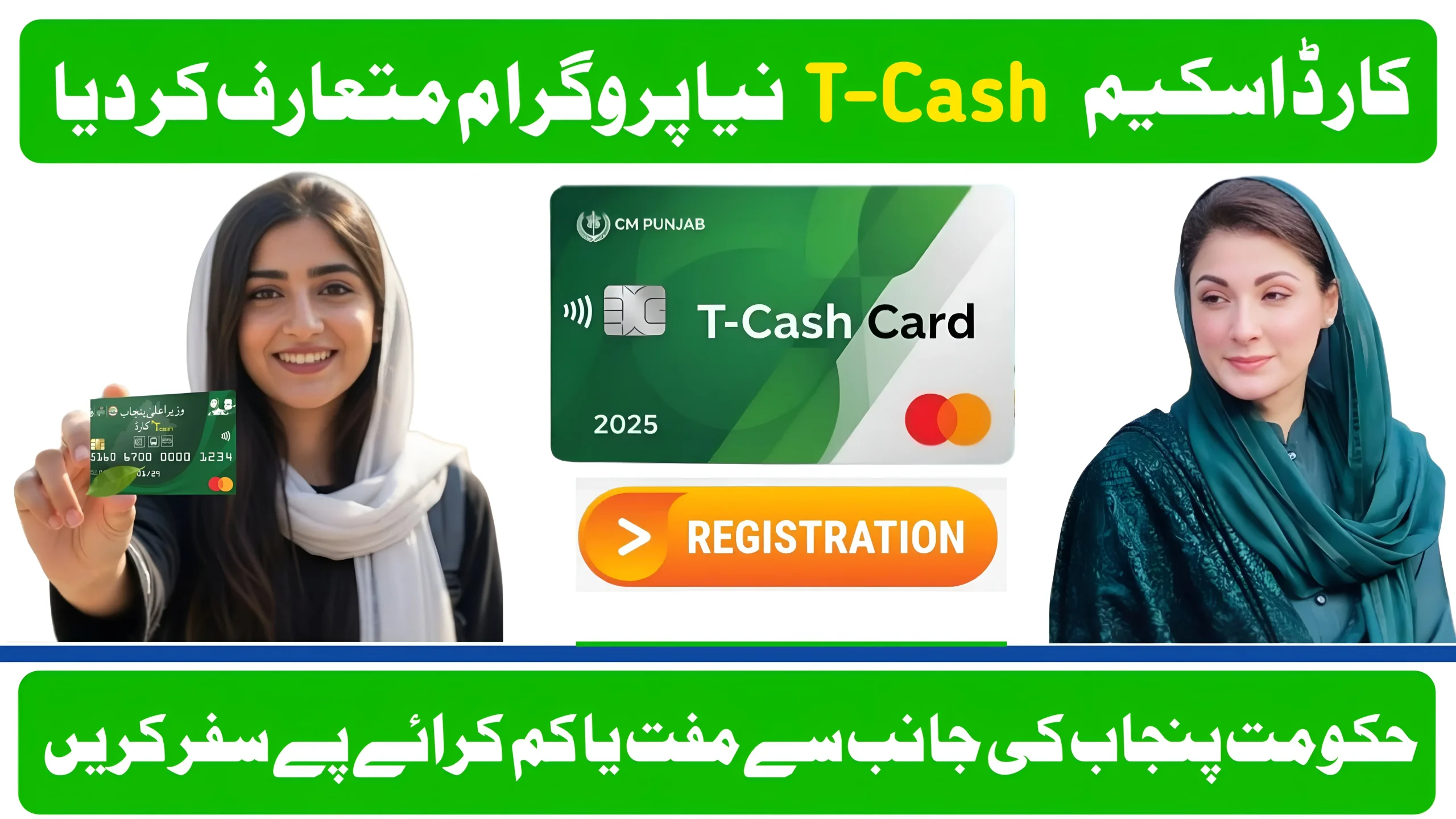
CM Punjab Launches T-Cash Card 2025: A Digital Revolution in Student Welfare
Chief Minister of Punjab, Maryam Nawaz Sharif, has officially unveiled the groundbreaking CM Punjab Launches T-Cash Card 2025 initiative. This ambitious program represents a significant leap forward from traditional cash-based aid systems, leveraging digital technology to provide direct, transparent, and efficient financial assistance to millions of students across the province.
The T-Cash Card 2025 is more than just a subsidy; it is a comprehensive digital ecosystem designed to empower the youth, alleviate financial burdens on low-income families, and pave the way for a more educated and skilled Punjab. This initiative underscores the government’s commitment to harnessing technology for public welfare, ensuring that benefits reach the intended recipients without delay or leakage.
Understanding the T-Cash Card 2025 Initiative
The T-Cash Card 2025 is a specialized prepaid debit card program launched under the broader Punjab Ehsaas Education Scholarship umbrella. Its primary objective is to provide a quarterly stipend to students from underprivileged backgrounds enrolled in public schools and colleges across Punjab. The “T” is widely understood to stand for “Transport” or “Travel,” indicating the card’s core purpose: to cover students’ daily commuting expenses to and from their educational institutions.

By directly addressing the cost of transportation, a significant barrier to school attendance for many, the government aims to boost enrollment rates, reduce dropout rates, and ensure that financial constraints do not hinder a child’s right to education.
Key Objectives of the Program:
-
Enhance Educational Access: Remove the financial obstacle of transport costs, encouraging consistent school attendance.
-
Financial Empowerment: Provide direct cash transfers to families, enabling them to support their children’s education without straining their budgets.
-
Promote Digital Inclusion: Introduce students and their families to formal banking and digital transaction systems.
-
Ensure Transparency: Eliminate middlemen and corruption through a direct, biometric-verified transfer mechanism.
-
Support Local Economy: The stipend is expected to be spent locally, providing a boost to small businesses and transport services.
Eligibility Criteria: Who Can Benefit?
The T-Cash Card 2025 is targeted specifically at students who need it the most. The eligibility criteria are designed to be inclusive yet precise.
-
Residency: Must be a permanent resident of Punjab.
-
Enrollment: Must be enrolled in a government-run school or college (primary to higher secondary level).
-
Family Income: The student’s family must fall below a certain poverty threshold, as determined by the Punjab Social Protection Authority’s data and surveys.
-
Attendance: Students must maintain a minimum attendance rate (e.g., 80%) to continue receiving the benefit, incentivizing regular schooling.
Prospective beneficiaries are identified through a robust registration process that cross-references data from educational institutions and the national socio-economic registry.
Features and Benefits of the T-Cash Card
The card is designed for simplicity, security, and utility.
-
Direct Cash Transfer: The stipulated amount (expected to be between Rs. 1,000 to Rs. 2,000 per student per quarter) is directly loaded onto the card.
-
Financial Tool: It functions like a standard debit card, allowing withdrawals from ATMs and payments at Point-of-Sale (POS) machines.
-
Restricted Usage: While functional as a debit card, its primary intent is for education-related expenses. Merchants categorized under education supplies, transport, and stationery are encouraged.
-
Security: The card is PIN-protected and linked to the beneficiary’s biometric data, minimizing risks of fraud and misuse.
-
Convenience: Families no longer need to travel to distant government offices or wait in long queues to collect funds.

The Application and Registration Process
The government has streamlined the registration process to be as accessible as possible.
-
Data Collection: The primary method is through automated data sharing between school administrations and the program’s management unit. Students already enrolled in government institutions and meeting the criteria are automatically considered.
-
Web Portal/ SMS Service: A dedicated web portal and SMS shortcode service allow parents to check their child’s eligibility status by entering their Computerized National Identity Card (CNIC) number.
-
Verification: Eligible students are verified through their school principal and a final biometric verification of the parent/guardian at designated camps or bank branches.
-
Card Distribution: Upon successful verification, the T-Cash Card is dispatched to the student’s school for collection or delivered to their home address.
A Comparative Look: T-Cash Card vs. Previous Initiatives
The following table highlights how the T-Cash Card 2025 improves upon previous welfare schemes:
| Feature | Previous Cash Scholarship Programs | T-Cash Card 2025 Initiative |
|---|---|---|
| Delivery Method | Manual disbursement at designated centers | Direct digital transfer to a dedicated card |
| Transparency | Prone to delays and manual errors | High transparency with digital trail for every transaction |
| Security | Risk of cash theft or loss | PIN and biometric protected, easily blockable if lost |
| Efficiency | Involved significant administrative overhead | Automated system reduces processing time and costs |
| Scope of Use | Often limited to cash withdrawal | Can be used at ATMs, POS machines, and for potential online purchases |
| Targeting | Broader targeting sometimes led to inclusion errors | Precise targeting through integrated data from schools and BISP |
The Broader Impact: Beyond Financial Aid
The launch of the T-Cash Card 2025 is a policy move with multifaceted positive impacts.
-
Educational Impact: Higher attendance and enrollment rates directly contribute to improved literacy and numeracy outcomes for the province.
-
Digital Pakistan Vision: It serves as a practical step towards a cashless economy, familiarizing a new generation with digital financial tools.
-
Women Empowerment: By reducing the financial burden on families, it particularly encourages the education of girl children, for whom transportation safety and cost are often major concerns.
-
Economic Stimulus: The injection of funds directly into the hands of consumers at the grassroots level stimulates local economic activity.
Conclusion
The CM Punjab Launches T-Cash Card 2025 initiative is a testament to proactive and innovative governance. It moves beyond short-term aid and focuses on sustainable, long-term development by investing in human capital—the youth of Punjab. By seamlessly integrating welfare with technology, the government is not only addressing immediate economic hardships but also building a foundation for a more digitally literate and economically empowered society.
The success of this program will hinge on effective implementation, widespread awareness campaigns, and continuous monitoring. If executed as envisioned, the T-Cash Card 2025 has the potential to become a gold standard for social protection programs across Pakistan, truly transforming the landscape of educational support and setting Punjab on a path toward a more prosperous and equitable future.
